
Nobody wants to be the cautionary tale. But here is the version of events we keep seeing play out across the continent.
An organization gets serious about security. They hire the right people, run the training, tighten their access controls, and leadership signs off on the budget. Everyone feels reasonably confident. And then something goes wrong anyway, not because their defenses failed, but because someone else's did. A vendor. A payment partner. A software provider running on infrastructure three versions out of date. Someone with a key to the building who never bothered to lock their own door.
Third-party risk is not a new concept, but in Africa, where digital partnerships are being formed at a pace that procurement teams and security functions are struggling to match, it has quietly become one of the most consequential blind spots in the region's cybersecurity conversation. And most boards are not talking about it nearly enough.
The Perimeter You Think You Have Is Not the One That Exists
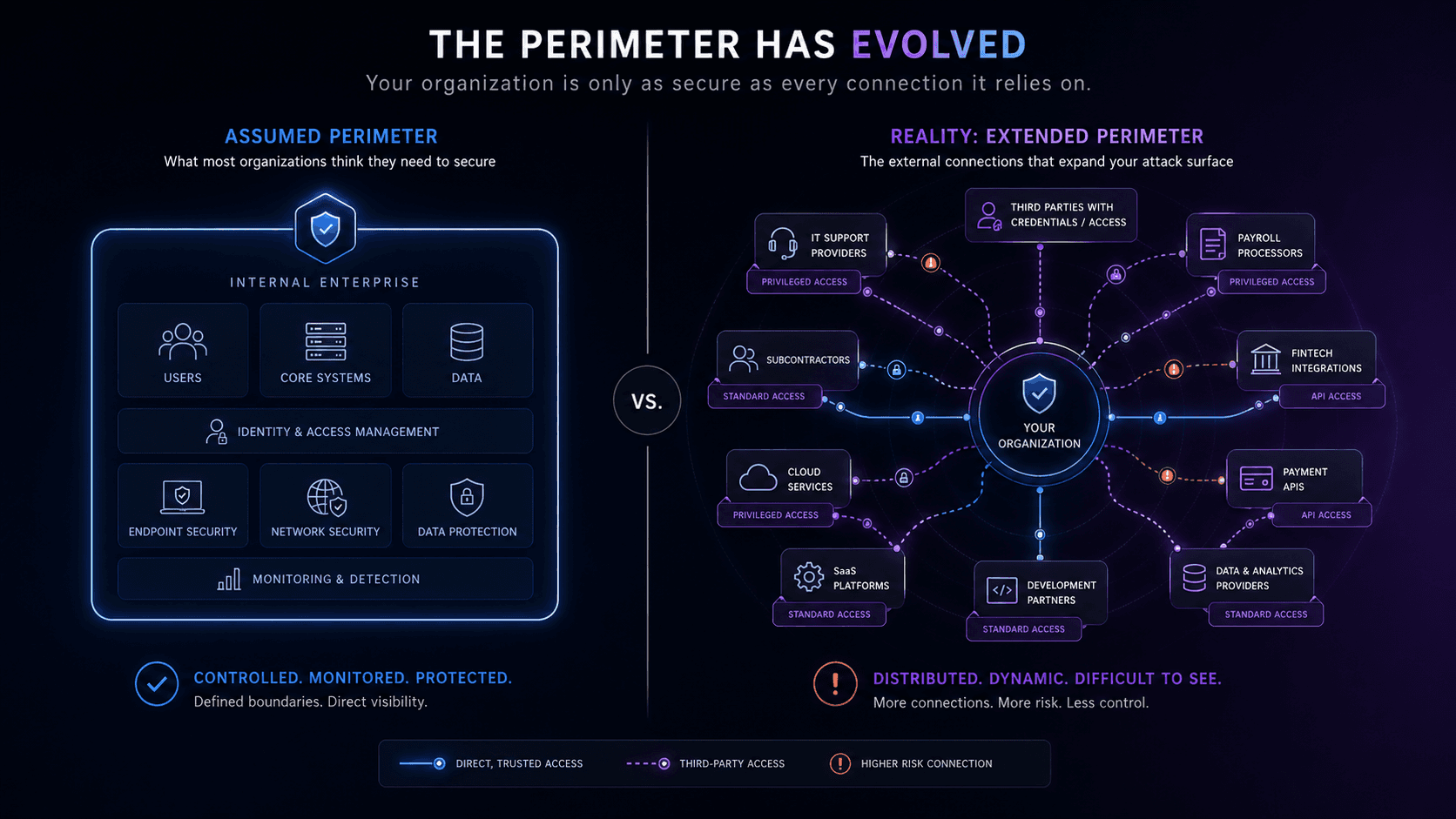
Here is a question worth sitting with. How many external parties have access to your systems right now? Not in theory. Actually, right now, with live credentials and active connections into your environment.
Most executives we speak to do not have a precise answer. They have a general sense, a rough number, maybe a procurement list somewhere, but what they rarely have is a clear and current map of who is inside their perimeter, at what level of access, and with what security practices backing that up. That gap is exactly what attackers are looking for.
The logic is straightforward. Large, well resourced organizations are harder to breach directly, so rather than attacking the target head on, sophisticated threat actors look for the path of least resistance. They find the payroll processor, the IT support firm, the logistics partner, the fintech integration that went live six months ago and has not been reviewed since. They compromise that, and then they walk in through a door that was already open.
Across Africa, a few dynamics make this particularly acute. Fintech partnerships are being established quickly, often with data sharing agreements and system integrations that precede any formal security review. Software stacks are a patchwork of local and international providers with wildly inconsistent security standards. And informal vendor relationships, which are a normal and practical part of doing business across many markets on the continent, rarely come with the contractual security obligations that the risk actually warrants. The result is a perimeter that looks one way on paper and looks quite different in practice.
Where the Risk Actually Lives
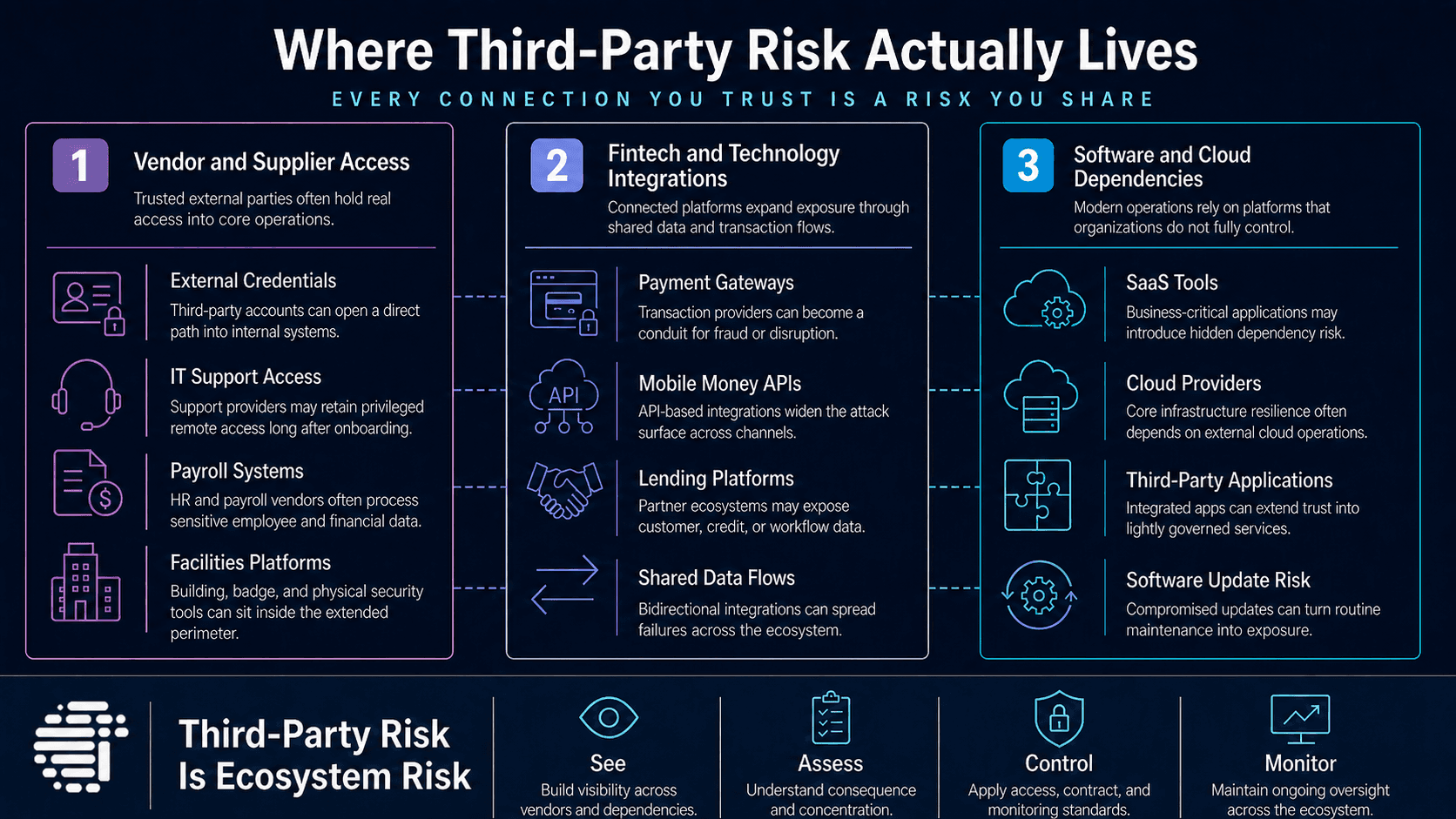
Third-party risk can feel abstract until you see where it actually concentrates, so it helps to be specific about this.
Vendor and supplier access is the most obvious category. Any external party with credentials into your systems carries risk proportional to both the depth of their access and the quality of their own security practices, whether that is an IT support provider, a payroll processor, or a facilities management platform. The question is not whether you trust these organizations. It is whether their security posture is genuinely good enough to justify the access you have given them.
Fintech and technology integrations are where we see some of the most significant exposure on the continent. Africa's fintech ecosystem is a dense web of interconnected systems, payment gateways, mobile money APIs, lending platforms, and data sharing arrangements, and each one is a channel through which a compromise at one organization can travel quietly into another. Shared access means shared risk, whether or not that has been formally acknowledged in the relationship.
Underneath all of this sit software and cloud dependencies. Every SaaS tool, every cloud platform, every third-party application in your stack is a potential point of failure, and a vulnerability in a widely used product does not discriminate between the organizations running it. When it gets exploited, everyone who depends on that software is exposed at the same time. The question is whether your organization has the visibility to know when that happens and a plan ready to respond before the damage compounds.
The Due Diligence Illusion
Most organizations that have thought about third-party risk have some version of vendor due diligence in place. A questionnaire at onboarding, a review during procurement, an annual check in. It feels like governance, but in practice it is closer to a snapshot of a moving target.
Due diligence tells you what a vendor's security posture looked like on the day you asked. It says nothing about what happened the following quarter when they lost two security staff, pushed a rushed software update, or quietly onboarded a subcontractor without running any checks of their own. Security posture changes constantly, and point in time assessments simply do not capture that.
What actually works is ongoing visibility throughout the relationship, not just at the start of it. That means setting minimum security standards as a condition of doing business and enforcing them in contracts, defining what breach notification looks like and how quickly a vendor is expected to inform you, and knowing before something goes wrong which of your third parties would cause the most damage if compromised. Some third-party risk cannot be eliminated. It can only be understood, monitored, and planned for, and the organizations that have done that work respond to incidents significantly faster than those that discover the gap at the worst possible moment.
Regulators Are Starting to Ask Different Questions
For a long time, regulatory attention in Africa focused primarily on how organizations handle their own data. That is changing, and faster than most organizations have noticed.
Nigeria's NDPR, South Africa's POPIA, and Ghana's Data Protection Act are all creating expectations around how organizations manage data they share with third parties, not just the data they hold directly. Regulators are beginning to ask about vendor contracts, data processing agreements, and what happens to personal data once it leaves your systems and enters someone else's environment.
This matters practically because a breach that originates at a vendor can still result in regulatory consequences for the organization whose data was exposed. The fact that it was a supplier's systems that failed is relevant context but it is not a defense. If your data was compromised, the question regulators ask is what you did to prevent that and what your oversight looked like. Most organizations across the continent are not yet set up to answer those questions confidently, which means getting ahead of this is both a risk management decision and increasingly a compliance one.
What Needs to Change
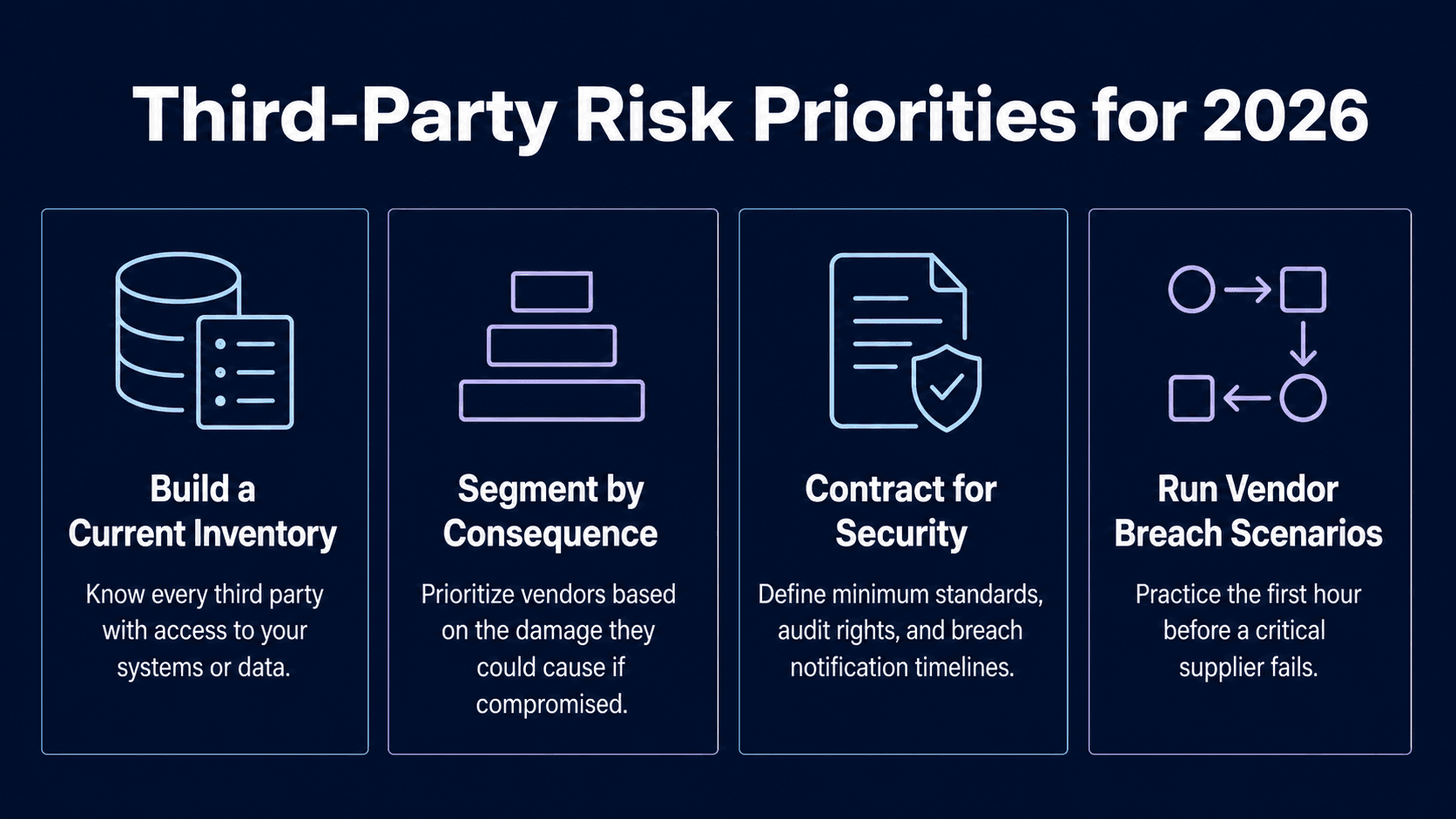
Start with the inventory, because everything else depends on it. A complete and current picture of every third party with access to your systems or data sounds basic, but most organizations genuinely do not have one.
From there, segment by consequence. The payment processor with access to your core financial infrastructure is a fundamentally different conversation from the agency managing your social media, and your scrutiny should reflect that. Build security requirements into the contracts that govern your highest risk relationships. Right to audit clauses, breach notification timelines, and minimum security standards are not aggressive terms. They are reasonable expectations that mature vendor relationships already carry, and there is no reason African organizations should accept less.
Finally, run the scenario before it happens. If a critical vendor were breached tomorrow, what would your first hour look like? Who gets called, what gets isolated, and what do you tell clients? The organizations that have worked through those questions in advance make far better decisions when it actually counts.
The Bottom Line
Attackers are practical. They go where the resistance is lowest, and right now across much of the continent, the lowest resistance is not inside well defended organizations. It is in the ecosystem of vendors, partners, and providers those organizations depend on and quietly trust without always verifying.
Third-party risk will not stay overlooked for much longer. Regulatory pressure is building, threat actors have already figured it out, and the window to get ahead of this rather than respond to it after the fact is narrowing faster than most executives realize.
Idero's Vulnerability Management and Regulatory Assurance practice helps organizations build the visibility and governance frameworks that third-party risk demands. Get in touch to find out what that looks like for your organization.