
There is a particular kind of confidence that comes from a clean audit. The findings are closed. The frameworks are documented. The certificates are framed. Leadership breathes a little easier, and the security conversation moves to the back of the agenda until the next review cycle.
We understand why that feels like enough. Compliance is hard work. Meeting the requirements of NDPR, POPIA, ISO 27001, or any number of regional frameworks demands real investment, real time, and real organizational effort. Passing an audit is not nothing.
But it is not resilience either.
What Compliance Actually Measures
Audits are designed to answer a specific question. At this point in time, does this organization meet the defined requirements of this framework? That is a useful question. It is just not the same question as whether an organization can withstand, adapt to, and recover from a real attack.
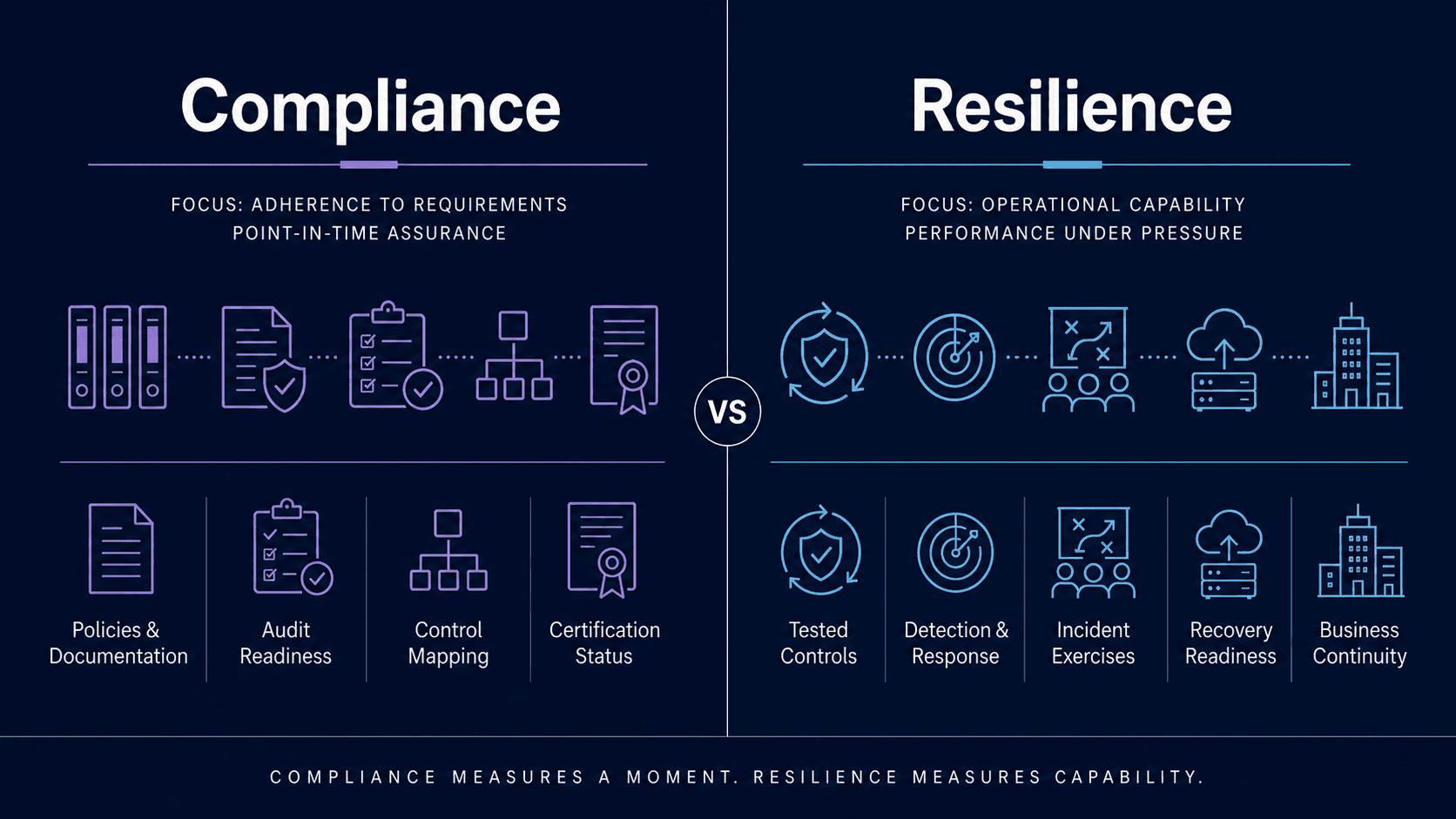
Compliance measures a moment. Resilience measures a capability.
A framework tells you what controls to have in place. It does not tell you whether those controls work under pressure, whether the people operating them make sound decisions at two in the morning, or whether the organization can keep functioning while an incident is being contained. Those things only reveal themselves when something actually goes wrong.
The gap between having the right documentation and having a genuinely hardened organization is where most breaches live. And it is a gap that a clean audit report will never show you.
Why the Confusion Persists
Part of the reason organizations conflate compliance and resilience is that the language around both is often the same. Frameworks use words like risk management, incident response, and business continuity. Those sound like resilience. But meeting the documentation requirement for an incident response plan is not the same as having tested it, refined it, and built the muscle memory to execute it under real conditions.
There is also a structural incentive problem. Compliance has deadlines, auditors, and consequences for failure. Resilience does not. Nobody sends a letter saying your recovery time objective is untested or your detection capability has never been validated against a real threat scenario. The urgency is invisible until it is not.
Boards and executive teams respond to what is measured and reported. If the only security metric reaching the boardroom is audit status, that is what gets prioritized. Resilience, which is harder to quantify and slower to build, gets deferred.
What Genuine Resilience Actually Looks Like
Resilient organizations do not look dramatically different from compliant ones on paper. The difference is in what happens beneath the surface.
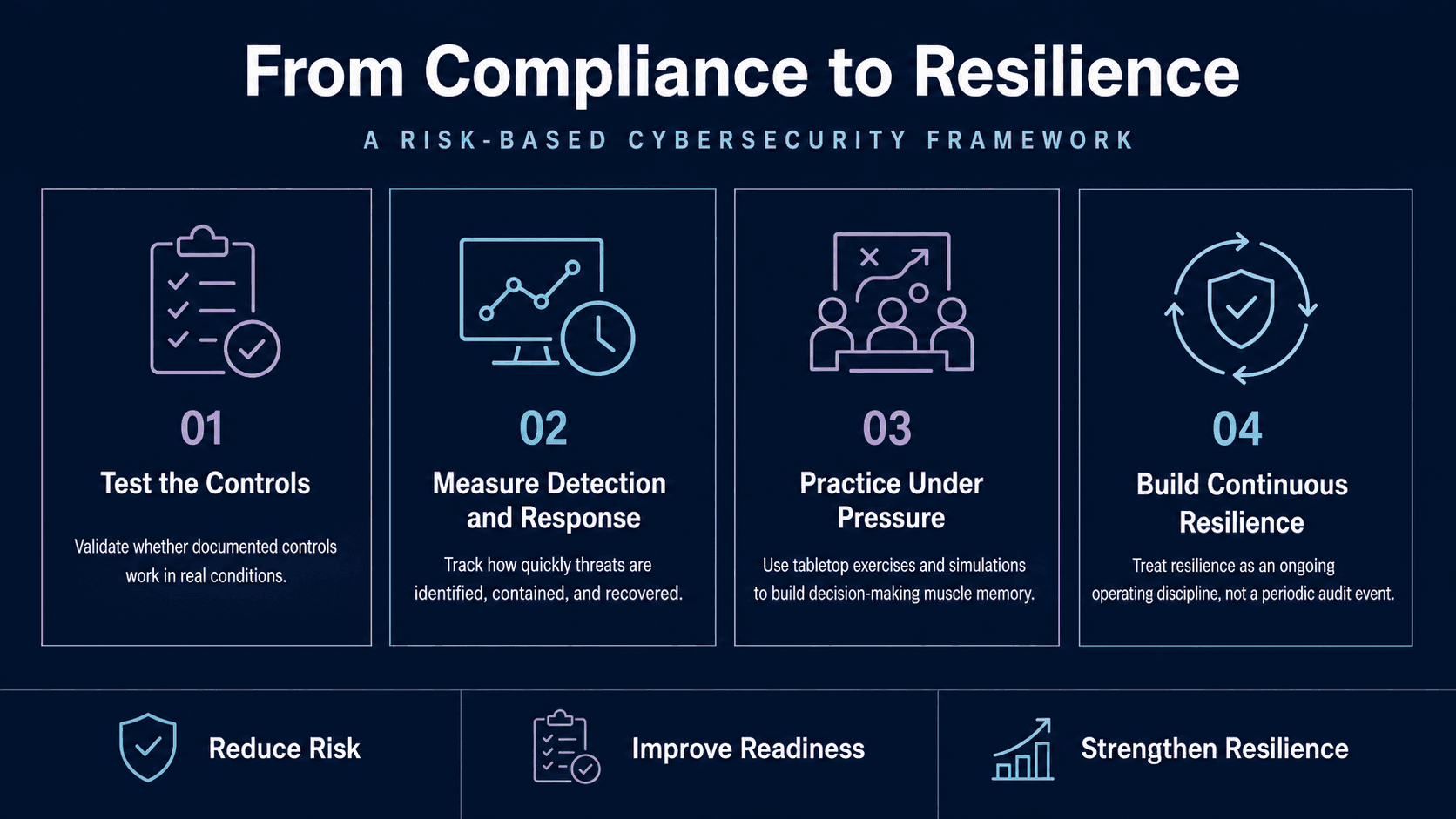
They test their controls rather than just documenting them. Penetration testing, red team exercises, and simulated incident scenarios tell you whether your defenses hold under realistic conditions. A policy that has never been stress tested is a hypothesis, not a control.
They measure detection and response capability, not just prevention. The question is not only whether an attack can get in but how quickly the organization knows when one has, and how effectively it can contain and recover. Organizations that only measure prevention are optimizing for the wrong outcome.
They treat resilience as an ongoing operational discipline rather than a periodic compliance exercise. Threat landscapes change. Attack techniques evolve. An organization that was genuinely resilient eighteen months ago may have meaningful gaps today if it has only been maintaining compliance in the interim.
And they make sure the people responsible for executing under pressure have actually practiced doing so. Plans that live in documents and people who have never rehearsed them are not the same as organizational capability.
Tabletop exercises are one of the most underused tools available for building that capability. Walking the right people through a realistic attack scenario reveals gaps that no audit will ever surface. Who makes the call to take systems offline? Who notifies the regulator? Who speaks to clients? These questions should never be answered for the first time during an active incident.
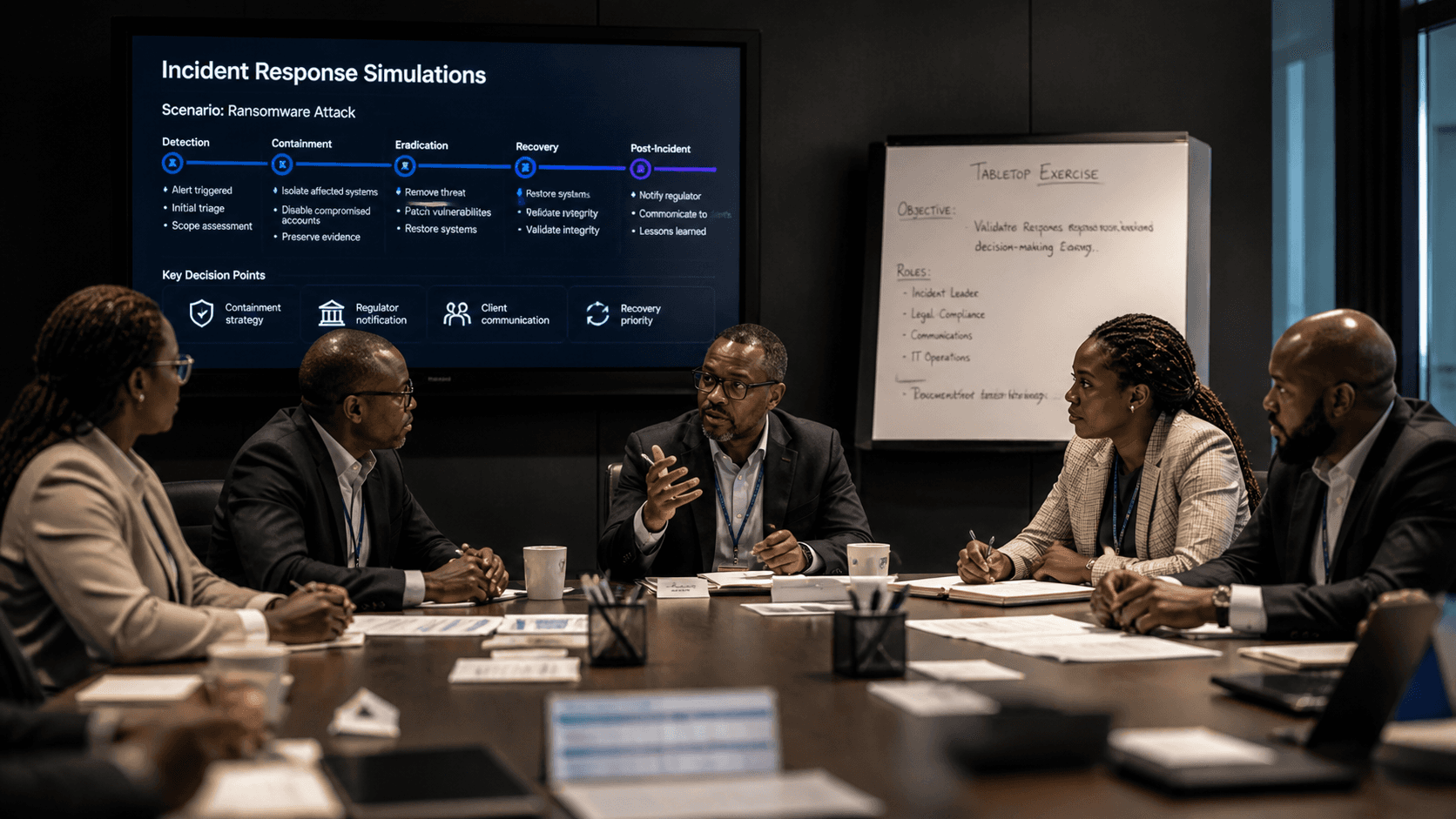
Incident response testing takes this further. A documented plan gives organizations confidence. A tested one gives them capability. Running periodic drills, whether a simulated ransomware event or a data exfiltration scenario, builds the muscle memory that determines how quickly an organization recovers when something real happens. The difference between a two day recovery and a two week recovery often comes down to whether the team has practiced.
The Regulatory Reality
None of this means compliance does not matter. It does, and the regulatory environment across Africa is making it matter more with each passing year. NDPR enforcement is tightening. POPIA has teeth. And Ghana's newly launched Cyber and Information Security Directive, CISD 2026, is sending a clear signal about where the continent is heading.
The Bank of Ghana's Governor described CISD 2026 as a directive that goes beyond compliance to promote active and collective cyber resilience. Financial institutions, fintechs, and payment service providers in Ghana are now operating under mandatory board level accountability for cybersecurity. That is a standard other regulators across the continent are watching closely.
The point is not to choose between compliance and resilience. It is to understand that compliance is the floor, not the ceiling. Meeting regulatory requirements keeps you out of trouble with auditors and regulators. Building genuine resilience is what keeps you operational when an attack lands.
The organizations that treat compliance as the destination rather than the starting point are the ones that pass their audits and then spend weeks recovering from incidents that their frameworks technically required them to be prepared for.
The Bottom Line
A clean audit report is worth having. It signals organizational discipline, demonstrates accountability to regulators and clients, and creates a foundation to build from. But it is a snapshot, not a guarantee.
The question worth asking after every audit is not just whether the findings are closed. It is whether the organization could absorb a serious attack today and keep functioning. Whether the detection capability is real. Whether the response plan has been tested. Whether the people responsible for security decisions are equipped to make them under pressure.
Those questions do not appear on audit checklists. But they are the ones that determine whether an organization is resilient or simply compliant.
Idero's Regulatory Assurance and Readiness practice helps organizations move beyond checkbox compliance toward security programs that hold up when it counts. Get in touch to learn how we can help build that foundation.